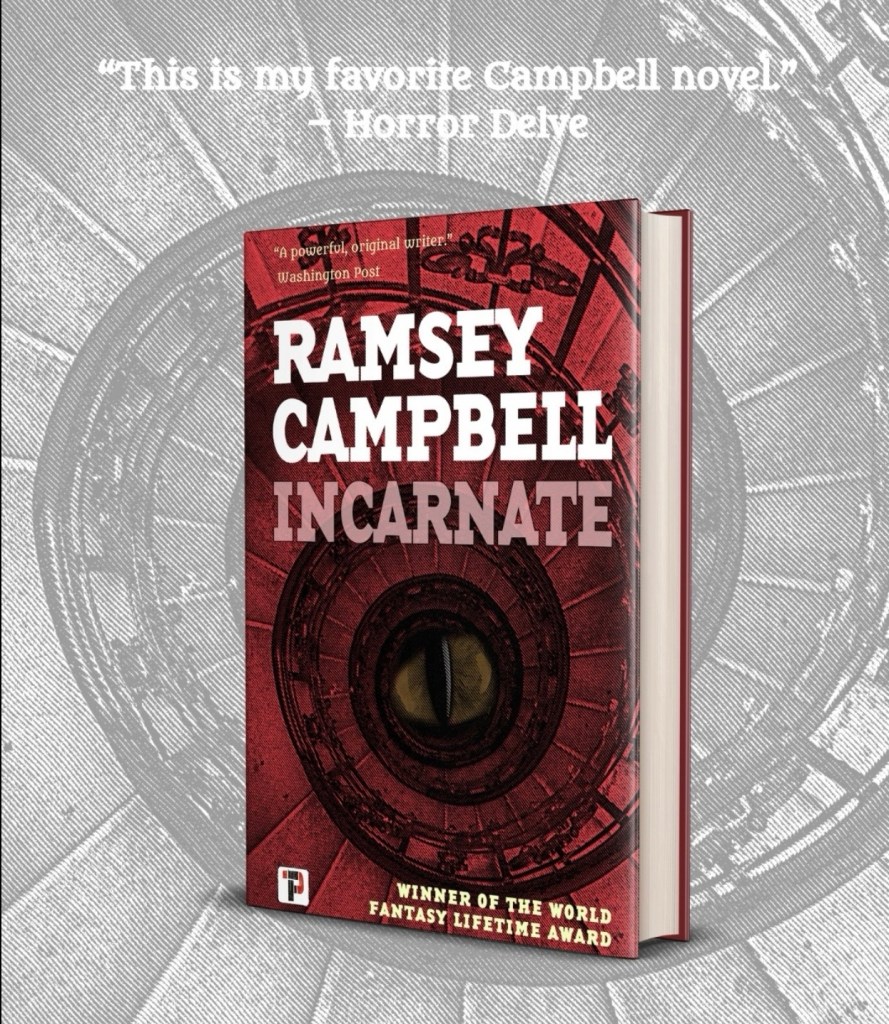
Back in 2014 I reviewed a handful of Ramsey Campbell novels I’d read and combined them into a single post ( https://horrordelve.com/2014/01/04/284/ ). Incarnate was among them, listed as my favorite Campbell novel. That’s why I’m thrilled to announce some exciting news. Incarnate has been rereleased by Flame Tree Press as part of their ongoing effort to re-publish several of Ramsey’s excellent 1980’s horror novels with new covers and layouts.
Here is the blurb from Flame Tree Press about Incarnate:
Five people take part in a study of precognitive dreaming, but the future they all dream of is a nightmare. Eleven years later, the dream creature they released creeps into all their lives in shapes they don’t realize are dreams. If it brings the five together again, far worse will be loosed on the world. Can Molly Wolfe, one of the dreamers, track down everyone involved in time to stop it, or is her search doomed to help it achieve its inhuman aim? Is she too unaware of the way the dream creature has insinuated itself into her life?
I would add this brief additional commentary from my own previous review:
‘This is a wonderful journey into a bizarre realm where you can never be certain who or what are real and what consequences the experiments brought forth. This one has stuck with me despite the many years since I read it.’
As a special treat to celebrate this rerelease, I was able to score an interview with the bestselling, multi-award winning author of Incarnate and my personal favorite writer, Ramsey Campbell!
THE INTERVIEW:
M.C. (Matt Cowan): This rerelease of Incarnate is part of an ongoing program by Flame Tree Press to bring many of your classic titles back into print for whole new generations of readers to enjoy. How does it make you feel to have your older works still in demand today?
R.C. (Ramsey Campbell): I’m happy that folk still find my old stuff worth reading. I confess that when I reread them—I’m sent proofs of the reissues to check, you understand—I generally find them better than I feared they might have grown. I don’t write exactly or often even much like that now, but I’m happy to learn the tales work in their own way. Incarnate was one of the crucial turning points in my output, where I gave up trying to pump up the dread rather than letting the material speak for itself, however it might. Specifically, when I came to the scene in which the stamp dealer sees the Queen’s heads turn to him, I took the decision not to labour at making it more disturbing (however I might have) but instead to abandon striving to direct the reader’s response (as I had very visibly, I think, in The Parasite in particular). I no longer believe the writer can or should do so—I’m content to convey my imaginative experience as best I can and hope it engages the reader.
M.C.: Thinking back on when you were writing Incarnate, what sparked your inspiration to write it?
R.C.: Like a lot of my stuff, the development moved so far away from the initial idea that the latter was left behind. The original notion was an outbreak of terminal insomnia, perhaps affecting several characters. Once I began to ponder what purpose it would have I concluded it might be designed to combat an invasion by dreams, and this idea took over, as you see. I rather think a fellow writer all our readers will have heard of wrote an insomnia novel, but this was pure coincidence, or does it mean our dreams are at large in the world and seeking minds to find a home in?
M.C.: Among your acknowledgements in the 1983 version of Incarnate, you thanked John Owen for allowing himself to be taken to a Spiritualist meeting. Could you speak on that experience, and did it help with the development of the novel?
R.C.: I should first talk a bit about John, who was a fellow member of the Liverpool Science Fiction Group. As Frank Mace he wrote “The Ideal Type” in Dark Mind, Dark Heart, and “The Cuckoo Clock” in London Mystery Magazine. The latter journal deftly bought all rights by hiding its contract on the back of the cheque. Though I’m sure John became too seasoned to fall for that since, he didn’t realise that the tale had been filmed for Alfred Hitchcock Presents (adapted by Robert Bloch, no less) until Universal contacted him decades later to inform him it was being remade.
Anyway, that was John. The point was simply that he attended such a meeting, quite independent of my research, and I was able to pillage details he recalled of the experience for a related scene in my novel.
M.C.: Were you able to draw upon any of your own dreams while writing it?
R.C.: I have many—did then, too—but no, none of them figure in the book. That said, I’ve always appreciated dreams: free surrealist narratives, I feel they are (free both in their form and in not requiring payment). Jenny knows not to wake me if I’m audibly having a nightmare, since I believe those have their own built-in release mechanism if things get too intense.
M.C.: In your Three Births of Daoloth trilogy, you introduced an organization presenting themselves as attempting to help children who were having trouble sleeping called Safe to Sleep. We later learn there were ulterior motives involved. Given the dream connections of both, could there be any correlation between the entity Daoloth and the forces at play in Incarnate?
R.C.: I wasn’t conscious of one, but I wouldn’t dare to dismiss the insight, let alone the entity.
M.C.: Do you have any advice to readers who are about to embark on their journey through the pages of Incarnate for their first time?
R.C.: I set out to guide you, but don’t trust me not to let go of your hand. If I do, something else may take it instead.
M.C.: Thank you for agreeing to the interview.
R.C. : My pleasure!
Flame Tree Press Incarnate Link: https://www.flametreepublishing.com/incarnate-isbn-9781787587700.html

 Horror Delve