John Linwood Grant has been featured several times here at Horror Delve over the past few years. I reviewed his Sherlock Holmes novella A Study In Grey back in 2016 ( https://horrordelve.com/2016/05/26/a-study-in-grey-by-john-linwood-grant-review/ ) and even interviewed him that same year as well ( https://horrordelve.com/2016/10/06/john-linwood-grant-interview/ ). In 2019 I reviewed the anthology Hells Empire: Tales of the Incursion he edited ( https://horrordelve.com/2019/09/15/hells-empire-tales-of-the-incursion-review/). He was kind enough to contribute to all three of the Ultimate Fantasy Lists I used to do here: Ultimate Fantasy Weapons ( https://horrordelve.com/2016/02/14/the-ultimate-fantasy-weapons-list/ ), Ultimate Fantasy Creatures ( https://horrordelve.com/2017/02/11/ultimate-fantasy-creatures-list/ ) and Ultimate Fantasy Places ( https://horrordelve.com/2018/02/26/horror-delves-ultimate-fantasy-weird-places-list/ ). Most recently I reviewed his absolutely brilliant story collection Where All Is Night, And Starless ( https://horrordelve.com/2021/09/13/where-all-is-night-and-starless-review/ ). Needless to say, he’s a fantastic author and editor who excels at writing in diverse genres.
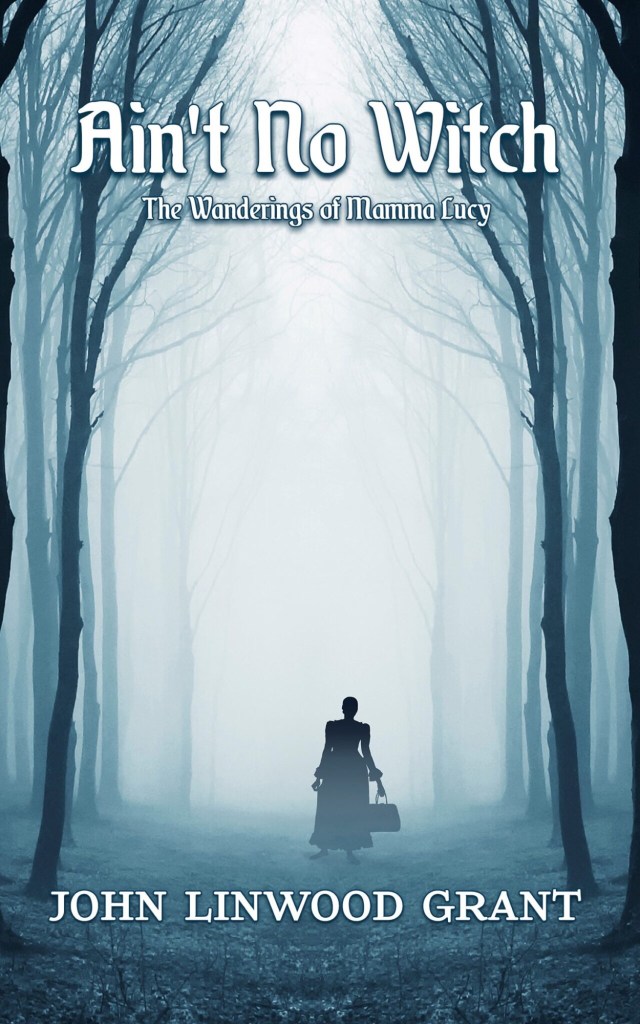
Upon learning John has a new book available from Mocha Memoirs Press titled Ain’t No Witch: The Wanderings of Mamma Lucy, I took the opportunity to ask him a few questions about it.
THE INTERVIEW:
1. Your new book Ain’t No Witch: The Wanderings of Mamma Lucy recently became available for purchase. What do its readers have in store for them?
Dark fables, I guess. Folk-horror is one term – folklore entwined with unquiet spirits, troubled places, and a sense of justice. There are horror stories here, but what constitutes that horror varies from tale to tale, and includes genuine haints and monstrosities along with people’s small and mean hatreds, their needs and mistakes. It’s a taste of, and a journey through, parts of the United States a century ago, as Mamma Lucy walks barefoot from one community to another along the Eastern Seaboard, drawn by trouble.
2. Who is Mamma Lucy?
She’s an ornery, willful conjure woman – a tall, slightly gangling Black woman who looks to be in her sixties, with one dark brown eye, and one of milk and honey which never quite settles. No one knows how old she is, or where she came from originally, but she’s flesh and blood enough, creaking bones and tired sinews under the strength. And her conjure, her hoodoo, has genuine power.
Mamma Lucy is no passing wise woman, offering a kind word or two, or a philosophical commentary. She acts, and can be brutal when needs be, considerate if it’s called for – if it’s deserved. Common sense and practical cunning are as valuable to her as conjure work, and she will always side with the poor, disenfranchised and desperate.
“Didn’t say as I could make all things right,” she said, picking up her bag. “Jess passin’ through to lessen some o’ what’s wrong.”
3. Ain’t No Witch is set during the 1920’s America. You’ve written several excellent stories set in different locales during various periods of history. What draws you to a specific place or point in time?
It’s feel. I have to feel that there’s some significance or relevance to what people do, good and bad, at particular times. Pivotal periods interest me, when changes are happening in society. Hence the Edwardian period and the Great War, the Harlem Renaissance and Jim Crow laws, the bleak parts of the 1970s, etc. As for place, if I feel I can ‘inhabit’ it in my mind, then I’ll use it. Locations I can’t grasp, I won’t use.
4. Mamma Lucy is more accepting as being referred to as a hoodoo woman, conjure lady or a root doctor rather than a witch. Did your research into the details of these designations turn up anything that surprised you in particular?
Not surprise, but fascinate. The more you research the history of such practitioners of the supernatural, paranormal or whatever you choose to call it – magic? – the more complex it gets. Hoodoo developed from Black African beliefs, but some of those were religious, some of them folklore, others about medicinal practices (root doctors are also herbalists). Then, over the years, there were interactions with Native Americans, rural white people, Christianity, and so on, which added to or changed some of the elements. So there is no one hoodoo, more a blend of approaches and practices with some common motifs.
Another thing some people don’t realize is that hoodoo began to be heavily commercialized in the first half of the twentieth century. Old-style hoodoo was very much about the practitioner making mojo bags, powders and herbal mixes from ingredients they gathered or found themselves, each to their own recipe and according to handed-down traditions – that’s how Mamma Lucy works.
As for the ‘witch’ title, yes, some conjure workers were called witches in some counties, but in both life and literature, it’s a very broad term with lots of different connotations, positive and negative. Mamma Lucy, as an old-style hoodoo woman and a Christian (in her own peculiar way), doesn’t take kindly to it.
5. Do you have future plans for Mamma Lucy beyond Ain’t No Witch?
The answer to that is Yes and No. I don’t have any publishing-type plans, but given the nature of the 1920s and what Black folk and other disenfranchised people faced back then, I have plenty of story ideas that I haven’t committed to yet, or which are only rough drafts. We’ll see how this volume goes down.
6. What other projects do you have forthcoming?
This year is a bit over the top. In June/July, I hope that my fifth collection ‘An Unkindness of Shadows’ will be out from Lethe Press – this one concerns a gay art critic in 1970s Britain, Justin Margrave, who keeps getting entangled, not always willingly, in weird and unnatural situations. Sculpture which isn’t quite right, ancient masks, curious coins, and damaged people. He’s no Mamma Lucy – he has no particular ‘powers’, and most of his encounters are troubles he neither wanted to find, nor has any idea what to do about.
The rest… I’ve been editing for two anthologies due out this year – ‘Alone on the Borderland’, new weird tales of Edwardian times, and ‘A Darker Continent’, which contains strange new stories of Europe at War (WWII). Both from Belanger Books. I hope to have a much expanded and revised version of my first ever collection ‘A Persistence of Geraniums’ out over the Summer, with new material in it, and then I have various other short story commitments to meet. Also, I’m still co-editor (with Dave Brzeski) of Occult Detective Magazine, so there’ll be two to three issues of that to complete. I’m… busy.
LINKS:
U.K. Amazon Link: https://www.amazon.co.uk/Aint-No-Witch-Wanderings-Mamma/dp/1962353095

 Horror Delve